

An event menu may pass through several hands before food reaches a guest: the organiser, the caterer, the kitchen team and the people serving the meal. Allergen information can become unclear when each team keeps a slightly different version of the menu.
A useful allergen matrix is a controlled record connecting a named dish with its current ingredient information. It supports communication, but it is not a substitute for competent food preparation or a promise that a dish is suitable for every person. The practical goal is to make accurate information available at the point where a question is asked.
Define exactly what the matrix records
The Food Standards Agency’s guidance for food businesses emphasises current ingredient records, the effect of recipe changes and measures to prevent allergen cross-contamination. It distinguishes knowing what a dish contains from managing what can happen during preparation and service.
Reflect that distinction in the document. An ingredient column records information from the recipe and supplier documentation. A separate preparation note can record a confirmed limitation or a question that the caterer still needs to resolve.
Do not let an empty cell mean whatever the reader assumes. If the information is still being checked, write “awaiting confirmation.” If a specific ingredient is confirmed present, say so. A blank space is especially unhelpful when printed copies circulate without their original explanation.
Give every dish a stable identifier
“Vegetarian lunch” is a category, not a precise dish name. It could refer to several recipes with different ingredients. Assign a stable name or code to each item so the kitchen record, service sign and organiser’s copy refer to the same thing.
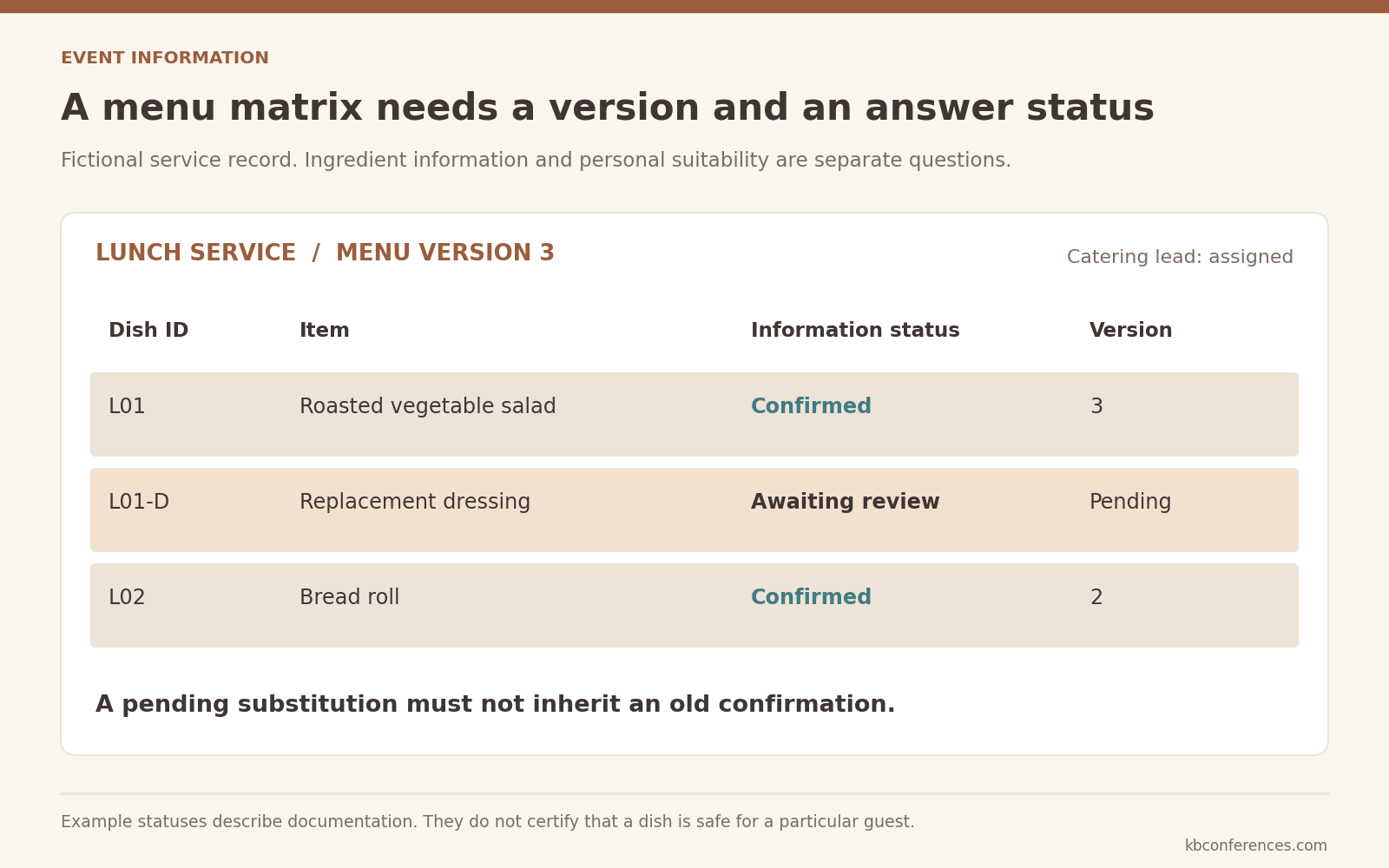
For a fictional menu, use identifiers such as L01 for a particular salad and L02 for a particular bread roll. If the recipe changes, keep the identifier attached to a version or change record rather than silently treating the new item as identical.
The identifier is not intended for guests to memorise. It gives the people handling questions a dependable reference. Clear public-facing names can sit alongside the internal code.
Keep ingredient presence separate from suitability
The FDA’s food-allergy information explains why identifying relevant foods and avoiding them matters for people with food allergies. It also sets out the major allergens recognised in United States labelling rules. Lists and legal requirements depend on the market, so an event team should use the framework applicable to its venue and supplier.
A matrix should not turn a limited ingredient observation into a personal medical conclusion. “Milk is listed in the current recipe” is a statement about that recipe. “Safe for this guest” requires more context than that one line supplies.
Similarly, broad menu labels such as plant-based, vegetarian or traditional do not provide a full allergen description. The actual ingredients and preparation arrangements remain relevant.
| Field | Fictional example | Purpose |
|---|---|---|
| Dish reference | L01, roasted vegetable salad | Connect the document to the served item |
| Recipe version | Version 3 | Identify the information reviewed |
| Ingredient information | Confirmed against supplier documents | Preserve the basis of the answer |
| Unresolved issue | Dressing substitution awaiting review | Make uncertainty visible |
| Responsible contact | Named catering lead | Route questions to the right person |
A substitution is a change to the information
A different bread, sauce or garnish can look like a minor service adjustment while changing the ingredients. Build a simple route for reporting substitutions before revised food is served under an old sign.
The person approving the change should update the relevant record and make sure the service team receives the new information. A note in one inbox is not enough if a printed matrix at the buffet still describes the previous item.
For an event with several service points, identify where each copy lives. This could include a registration desk, a catering station and a supervisor’s folder. A short distribution list makes replacing an outdated version more manageable.
Design the handover around real questions
Staff need to know how to find an answer without guessing. During the briefing, use a fictional question such as “Does this dressing contain sesame?” and follow the route from the dish identifier to the current information and the responsible contact.
If the answer is not confirmed, the useful response is to say that it needs checking and contact the appropriate person. A confident guess creates a false impression of certainty. The handover should make checking an ordinary part of the service process.
Keep the explanation short enough to use during a busy period. A detailed supplier folder may be necessary behind the scenes, while the service team needs a clear route to the relevant entry.
Check the document where it will be used
A spreadsheet that looks clear on an office monitor may be difficult to read as a small printed sheet. Test the final format, including line wrapping, font size and whether the dish names remain visible across page breaks.
Use words or clear symbols with a legend rather than colour alone. Keep the version and review date visible on every page. A screenshot sent through a messaging app can lose context, so ensure that the identifying information remains part of the image.
- Match each sign to a named item in the current record.
- Make unanswered questions explicit.
- Confirm who can approve and communicate a substitution.
- Replace superseded copies at all service points.
- Include the venue’s established emergency response arrangements in staff briefing.
Keep the underlying supplier document identifiable as well as the summary. For example, the working record can name the product, supplier and specification version used for the check. If two similar containers arrive, this gives the catering lead a way to establish which information applies. A matrix entry should remain traceable after the person who originally checked it has left the service area.
Close the loop after the event
Record where information became difficult to find or where a last-minute change created confusion. Those observations help improve the next menu handover without collecting unnecessary personal details about guests.
A well-managed matrix makes the chain of information visible: the exact dish, the current recipe, the evidence behind the entry and the person responsible for clarification. That organisation supports the catering team’s work and gives guests a more dependable route to answers about the food being served.

